
Chronic subdural hematoma care
MMA Embolization for Subdural Hematoma
A breakthrough in reducing recurrent bleeding around the brain.
Middle meningeal artery embolization (MMAE) targets the fragile blood vessels that sustain a chronic subdural hematoma. Randomized trials show that adding MMAE to appropriate treatment can reduce recurrence and the need for another operation. See the clinical evidence.
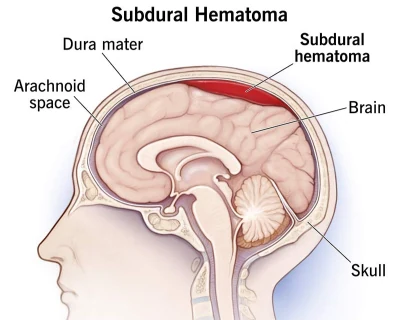
What is a chronic subdural hematoma?
A chronic subdural hematoma is a blood collection that develops over weeks, often after a fall or minor head injury. Older adults and people taking blood thinners are at increased risk. Sometimes there is no remembered injury. [7]
Inflammation creates membranes around the collection. Fragile vessels within these membranes can keep leaking, allowing the hematoma to persist, enlarge, or return after drainage. [5]
Evidence updated September 16, 2026
Why MMAE is changing subdural hematoma treatment
MMAE adds a treatment aimed at the blood vessels sustaining the hematoma. The clinical advance is a lower risk of recurrence or further treatment in several randomized trials, including two major studies published in 2026.
A strong recommendation for MMAE with surgery
The 2026 Society of NeuroInterventional Surgery (SNIS) recommendations give MMAE added to surgical drainage a Class I, Level A recommendation to reduce recurrence requiring another intervention, with the benefit weighed against procedural risk. This is the guideline's strongest recommendation; using MMAE alone has a more selective role. Read the recommendations. [1]
| Study | What was measured | MMAE added to care | Care without MMAE |
|---|---|---|---|
| EMBOLISE 2024 · 400 patients | Recurrence or progression leading to repeat surgery within 90 days; both groups had surgery. | 4.1% | 11.3% |
| EMMA-Can 2026 · 192 randomized | Symptomatic recurrence confirmed on CT at 90 days after surgery for a unilateral hematoma; 186 completed follow-up. | 4.3% | 28.0% |
| MEMBRANE 2026 · 376 patients | Residual or recurrent hematoma >10 mm at 6 months, or surgery within 6 months; standard care could be surgical or nonsurgical. | 11.6% | 22.1% |
MEMBRANE percentages are observed outcomes among participants with available data (146 and 131 patients); its primary analysis accounted for missing data. These are trial results, not an individual patient's predicted outcome or our practice's success rate. Sources: [2], [3], [4].
The evidence supports a substantial advance, not a guaranteed cure. Some trials, including MAGIC-MT and EMPROTECT, did not show a statistically significant improvement in their primary outcome. Patient selection, technique, and the outcome being measured matter. [4] [5]
Which treatment is right for you?
MMAE together with surgical drainage
Drainage removes blood and relieves pressure; MMAE addresses the membrane's blood supply to reduce recurrence. For an appropriate patient who needs drainage, adding MMAE is an evidence-based treatment option supported by the 2026 SNIS recommendations. [1]
MMAE without surgical drainage
Selected stable patients may be treated with MMAE alone when immediate decompression (relief of pressure on the brain) is unnecessary. SNIS considers this reasonable in special circumstances, including high surgical risk, bleeding disorders, or older age (Class IIa, Level B-NR). It requires individualized assessment and imaging follow-up. [1]
When surgery is urgent
Significant brain compression or worsening neurological function may require prompt surgical drainage. MMAE's effect develops gradually and must not delay necessary surgery. A new acute bleed, or fresh bleeding into a chronic collection, needs urgent reassessment. [7]
How the decision is made
Symptoms, CT findings, neurological examination, medications, and overall health guide treatment. Some small, stable collections can be monitored. Others require drainage, MMAE, or both. Do not stop or restart a blood thinner without the treating team's instructions.
What happens during MMAE?
Through a small access point at the wrist or groin, the specialist uses X-ray guidance to place a microcatheter (a very thin, flexible tube) in the target artery. Through this tube, the specialist delivers embolic material, which blocks the targeted blood supply. Embolization does not require opening the skull. Sedation or general anesthesia is selected for the patient. [6] [4]
Recovery and follow-up
Discharge timing depends on symptoms, other treatment, and recovery; a hospital stay may be needed. Follow-up CT scans track shrinkage over weeks to months. Your team will give activity, medication, and follow-up instructions. [6]
Benefits and risks
The main demonstrated benefit is reducing recurrence or treatment failure in appropriately selected patients. MMAE is minimally invasive, but serious complications can occur, including stroke, visual injury, and bleeding. [6]
In EMBOLISE, serious events related to embolization occurred in 2.0% of treated patients, including two disabling strokes. Results across studies do not establish a universal survival or disability benefit. Your specialist should discuss the expected benefit and procedural risk for your situation. [2]
Symptoms and diagnosis
A chronic subdural hematoma may cause persistent headache, changes in memory or alertness, difficulty walking, weakness, or trouble speaking. A head CT is usually the first imaging test; the examination and scan help determine how urgently treatment is needed. [7]
Request a subdural hematoma evaluation
Neurovascular Centers evaluates patients for MMA embolization and coordinated subdural hematoma care. Bring your recent CT or MRI images and reports, hospital records, and medication list so we can assess the best next step.
Serving Pasadena, Long Beach, and Orange County.
Clinical evidence and further reading
- Mascitelli JR, et al. SNIS Standards and Guidelines Committee recommendations, 2026. Journal of NeuroInterventional Surgery.
- Davies JM, et al. EMBOLISE, 2024. New England Journal of Medicine.
- Shankar JJS, et al. EMMA-Can, 2026. JAMA.
- Kellner CP, et al. MEMBRANE, 2026; corrected August 10, 2026. JAMA Neurology.
- Shotar E, et al. EMPROTECT, 2025. JAMA.
- UCSF Health. Middle Meningeal Artery Embolization: patient information.
- MedlinePlus. Subdural hematoma: symptoms, diagnosis, and emergency care.
General educational information. Treatment depends on an individual medical evaluation.
More patient resources
Explore the Subdural.com guide
Our dedicated guide covers subdural hematoma, symptoms, diagnosis, treatment, and recovery for patients and families.
Visit Subdural.com ↗